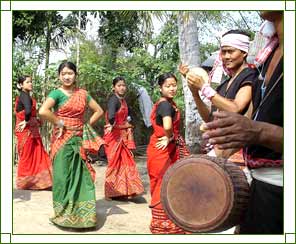
It is often said that folk dance is the best manifestation of the culture and tradition of a particular place. The best example to this statement can be seen in the various ethnic dance forms that are prevalent in the different corners of Assam. The state is home to a number of indigenous tribes and races, each of which has its own fairs and festivals. This has led to the propagation of innumerous dance forms throughout the region. The different dance forms in the state can be broadly categorized under two headings, classical dances and folk dances.
Classical Dance
Bhaona - This dance form is basically performed in the village Namghars and Satras, in order to promote the Vaishnavite culture in Assam. It is actually a theatrical depiction of the one-act play Ankiya Nat, initiated by Sankardeva. An integral part of the dance is the Sutradhara, who recites the slokas, sings, dances and explains the various stages of Bhaona in detail. Another form of dance included in Bhaona is the Natuwa or Cali dance. One of the subdivisions of this dance form is the Hajowaliya, which is basically a woman’s dance and is the combination of both Tandava and Lasya.
Oja Pali - Oja- Pali is a form of classical dance, representing the rich tradition and cultural heritage of Assam. Oja and Pali are actually a group of chorus singers and dancers, with Oja as the leader and Palis as his assistants.
Satriya Nritya - Satriya dance is a renowned classical dance of the state of Assam and was introduced by Srimanta Shankardev to propagate the religion of Vaishnavism.
Folk Dances
Bihu Dance - This is the most popular folk dance of Assam and as the very name suggests, is related to the Bihu festival, which is celebrated with much pomp and glory throughout the state.
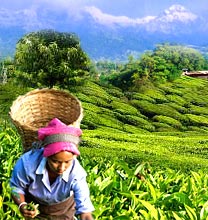
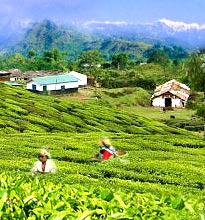
Jumur Nach - This is a typical folk dance performed by the tea community in the state, locally called ‘Chah Baganar Jumur Nach’ or the Jumur dance of tea garden. Boys and girls hold each other’s waist and dance to the tunes of the Jumur dance, with exact precision of foot work. Watching them sway to the tunes of the song is indeed a very pleasant experience.
Ali Ai Ligang dance - The Mishing community of Assam performs a dance while making an offering to their deities during the Ali Ai Ligang festival. This form of dance is seen only in the north-eastern parts of the state, namely Sonitpur and Lakhimpur.
Deodhani - Deodhani is a dance form associated with the worship of the snake goddess Manasa. This dance is performed by a girl who, in a trance-like inspired state, goes on dancing to the beats of the Ciphung (flute) and the Kham (drum). At one stage of the dance, she even takes a sword and a shield performing a virile war dance, honoring various gods and goddesses, like Shiva, Lakshmi etc.
Barpeta’s Bhortal Nritya - This form of dance is mainly a propagation of the Sankari culture of Assam and was originally developed by the well known Satriya artist, Narahari Burha Bhakat. During the festivals in the Barpeta and Guwahati regions, this dance is performed by a group of 6-10 dancers equipped with cyrnbols.
Dhuliya and Bhawariya - This is basically a form of theatrical performance, using masks, drums and cymbals.
Bodo’s Bagurumba - This is one of the best folk dances performed by the Bodo community of Assam. A number of Bodo girls, dressed in colorful apparels, dance to the tune of the tribe’s traditional musical instruments, with slow steps and outstretched hands. This is commonly seen in the Kokrajhar, Bongaigaon, Nalbari, Darrang and Sonitpur districts of Assam.
Khamba Lim - This is a typical folk dance of Assam, performed by two groups of men and women, who stand in two rows.
Bihu Dance
Bihu dance is the most popular folk dance of Assam and as its very name suggests, is related to the Bihu festival, which is celebrated with pomp and glory within the state. The festival is mainly a celebration of the different phases of cultivation and is observed by all the Assamese, irrespective of their caste and creed.
Oja-Pali Dance
Oja-Pali is a classical dance form of Assam, representing the rich tradition and cultural heritage of the state. Oja and Pali are actually the groups of chorus singers and dancers, with Oja as the leader and Palis as his assistants. A total of three or four Palis may be required for the dance and the principal one among them is called the Daina Pali. Apart from dancing, they also sing and play small cymbals, relating stories from the Epics and the Puranas.
Satriya Dance
Satriya dance is a renowned classical dance of Assam, which was introduced by Srimanta Shankardev to propagate the religion of Vaishnavism. This form of dance is one of the eight principal classical dance forms of India and has a great cultural significance in the social scenario of the state. The basic aim of the Mahapurush, behind Satriya dance, was to preach to the common people the religious teachings that were commonly inaccessible to them.





 It is often said that folk dance is the best manifestation of the culture and tradition of a particular place. The best example to this statement can be seen in the various ethnic dance forms that are prevalent in the different corners of Assam. The state is home to a number of indigenous tribes and races, each of which has its own fairs and festivals. This has led to the propagation of innumerous dance forms throughout the region. The different dance forms in the state can be broadly categorized under two headings, classical dances and folk dances.